BrainHealth Solutions treats Los Angeles patients with transcranial magnetic stimulation (TMS) for depression and OCD at our Costa Mesa clinic, about an hour south on the I-405 depending on traffic. Care is led by Dr. Robert Bota, the psychiatrist who founded UC Irvine's first TMS program.

Transcranial magnetic stimulation is a non-invasive, FDA-cleared treatment for major depressive disorder and OCD that uses focused magnetic pulses to stimulate nerve cells in brain regions that are underactive in depression. It is most often considered when medication or therapy has not worked or was not tolerated. At BrainHealth Solutions, TMS is delivered with MagVenture technology, and the same practice also offers the accelerated SAINT® protocol and Spravato®. For a Los Angeles patient that choice matters more than usual: the right option is partly a question of how often you can realistically make the drive to Costa Mesa.
A coil rests against your scalp and delivers brief magnetic pulses. The pulses pass painlessly through the skull and induce small electrical currents in the targeted cortex; nothing is implanted and no anesthesia is used.
Before your first treatment, the team performs motor-threshold mapping to find the stimulation intensity your brain responds to, then locates the treatment target. Coil design, pulse location, intensity and frequency all shape the effect, so this mapping is individual to you.
The effect is cumulative. One session does not relieve depression; a course of daily sessions gradually changes activity in the mood circuits, which is why most patients notice improvement after several weeks rather than several days.
TMS is FDA-cleared for major depressive disorder, OCD and smoking cessation, and insurers typically cover it for depression after two or more antidepressant trials have failed. Dr. Bota trained in TMS at Harvard University and the University of South Carolina and is a member of the Clinical TMS Society. All BrainHealth Solutions care happens at one location, the Costa Mesa clinic at 3151 Airway Ave, Bldg R, Costa Mesa, CA 92626; there is no Los Angeles office. Standard TMS means five visits a week for about six weeks, and from Los Angeles that is a real commute burden. Many LA patients who qualify for accelerated treatment choose SAINT® instead, which compresses treatment into one week, and the screening call is where that trade-off is talked through.

You share your name, contact information and a callback time. Our team explains TMS, SAINT® and Spravato®, and for Los Angeles callers, what each schedule looks like as a drive from home or work. You can also text the office first if you prefer.
A thorough visit at the Costa Mesa clinic covering your history, prior diagnoses and medications, medical background, sleep and goals. Insurance eligibility for TMS is reviewed at this stage, including the two-medication-failure criterion most plans apply.
At the first treatment visit the clinician determines your motor threshold and treatment target. This visit runs longer than a routine session because the settings it produces are used for the rest of your course.
Standard TMS is delivered five days a week for roughly six weeks, then tapered. You sit in a reclining chair, awake, and can read or talk during stimulation. You drive yourself home afterward.
Symptom scales are repeated through the course. Dr. Bota’s team adjusts the plan if progress stalls, and when the course ends you have a clear follow-up plan, whether that is medication management, psychotherapy or a maintenance schedule.
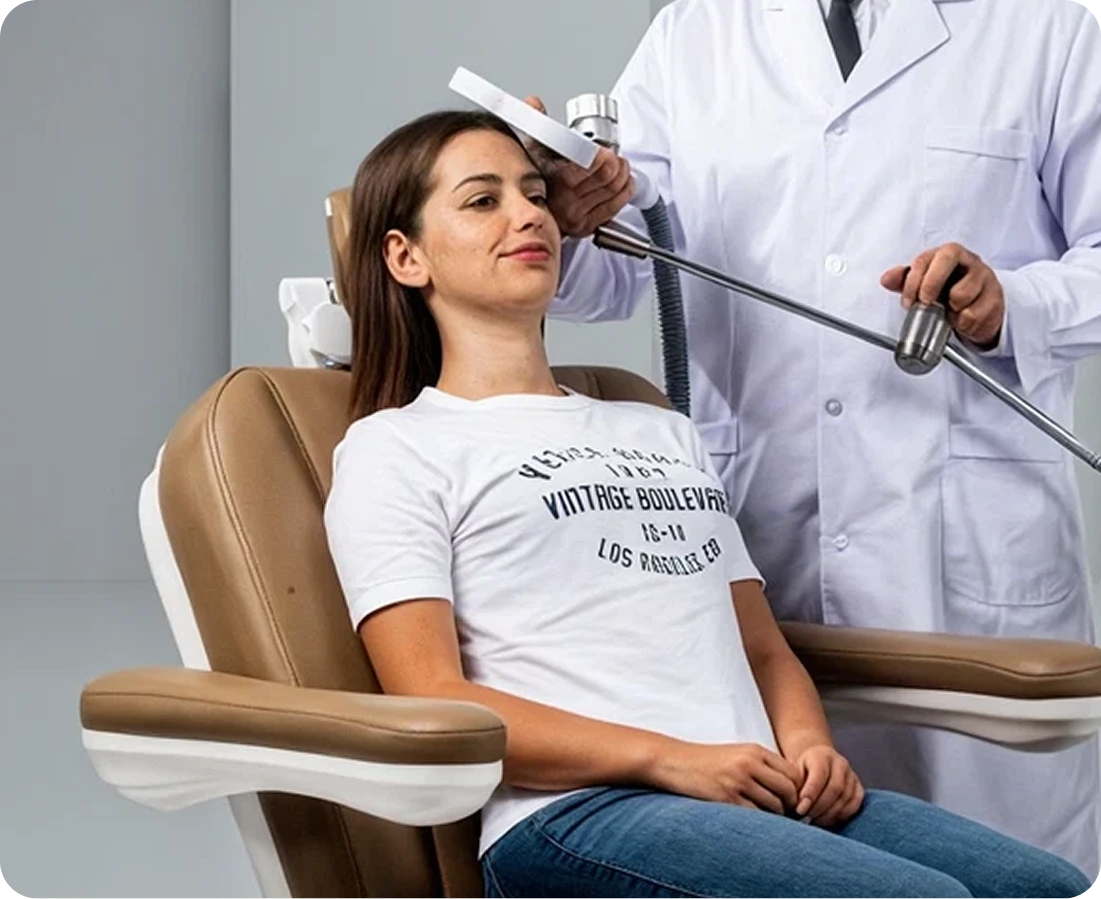
You remain awake and alert for the whole session. Most patients describe a tapping sensation on the scalp and hear a clicking sound; earplugs are provided. There is no sedation and no recovery period, so you can get straight back on the road.
Standard sessions last about 20 to 40 minutes depending on the protocol. Theta-burst protocols are shorter. The practice’s TMS technician guides you through every session so the routine becomes familiar within the first week.
The session is short; the drive is not. A Los Angeles patient should plan around roughly an hour each way on the I-405, depending on traffic, every weekday for six weeks. Patients who work in Orange County, or who can shift their hours, manage it best. If that is not realistic, say so on the screening call; SAINT® or Spravato®’s less frequent schedule may fit better.
A standard TMS course at BrainHealth Solutions follows the FDA-cleared schedule, all at the Costa Mesa clinic. Expect:

TMS has no systemic drug effects, so it does not cause the weight gain, sexual side effects or sedation associated with many antidepressants. Side effects that do occur are local and usually fade within the first week.
Common and mild
Hearing protection is used in every session because of the clicking sound of the coil.
Rare
Your clinician reviews your full medical history before clearing you for treatment and monitors you throughout the course.
Published studies of standard TMS for treatment-resistant depression report that roughly half to two-thirds of patients respond and about a third reach remission, with higher figures in naturalistic clinic data. Dr. Bota's practice tracks symptom scales through the course rather than relying on impressions.
Realistic expectations are part of good care. TMS is not typically a cure; it is a treatment that can lift a depressive episode and is sometimes followed by maintenance sessions, medication adjustments or psychotherapy to hold the gains.

Standard TMS at our Costa Mesa clinic may be a strong option for Los Angeles adults who:
TMS is generally not appropriate for people with certain metal implants in or near the head, a history of seizures, or some neurological conditions. These are reviewed at your evaluation.
Options that may suit a Los Angeles schedule better
Los Angeles patients who make the trip usually do so for the clinician, not the device. One patient wrote that “the TMS protocol was highly effective for my family’s needs,” and a mother described her son as “doing much better now” after his course.
No anesthesia, no systemic medication, no recovery time. You leave each session and can drive yourself home.
Most major insurers and Medicare cover TMS for depression once two medication trials have failed. The BrainHealth team verifies benefits before you start, so you know the cost before committing to the drive.
Motor-threshold mapping and target location are individual, not a preset. Dr. Bota’s research background in neuromodulation shapes the protocol choice.
TMS can continue while you stay on medication or in therapy. Many patients taper medication later, under supervision.
The same practice offers SAINT®, which replaces six weeks of daily visits with one treatment week, and Spravato®, so the commute does not have to decide whether you get treated.
Dr. Bota founded UC Irvine’s first TMS program and has helped bring TMS into mainstream psychiatric care.
Treatment-resistant depression usually means two or more adequate antidepressant trials without adequate relief. It is the population TMS was studied in and the population most insurers cover. For Los Angeles patients, six weeks of daily visits is often the real obstacle, so ask about SAINT®, which delivers ten sessions a day over five consecutive days at the Costa Mesa clinic.
Without insurance, TMS at BrainHealth Solutions’ Costa Mesa clinic typically ranges from $200 to $350 per session, depending on the treatment protocol. With insurance approval, patient responsibility is usually limited to copays or coinsurance per session, and many plans cover a large portion of treatment for depression. Because your plan’s TMS criteria, deductible and authorization process determine the real number, we give you a personal estimate after reviewing your benefits. Los Angeles patients should also budget for the round trip, which is one reason some choose the one-week SAINT® course.
Insurance and financing
BrainHealth Solutions accepts insurance and self-pay. Many major plans are accepted, including Medicare and Anthem, and CareCredit financing spreads self-pay costs over monthly payments. Submit your plan through the insurance-check form on our site, or ask on your 15-minute screening call, and our team confirms what your plan covers before you commit to anything.
Dr. Robert Bota, MD, MSG, DFAPA is a board-certified psychiatrist and Distinguished Fellow of the American Psychiatric Association. He trained in TMS at Harvard University and the University of South Carolina, founded and directed the first TMS program at UC Irvine, and has authored more than 60 peer-reviewed publications.
Dr. Bota has been principal investigator on more than 20 clinical trials in depression, schizophrenia, PTSD and Alzheimer’s disease, and the practice participates in brain-imaging research with Kernel neurotechnology. Treatment plans are informed by that research and reviewed as your symptoms change.
Care at BrainHealth Solutions is delivered by a team that includes psychiatrists Dr. Tina Allee and Dr. Mahtab K. Yousefi (child and adolescent care in English and Farsi), Spravato® specialist Dr. Dragos Serseni, TMS technician Anna Venezio and office manager Peter Bota.
Many plans are accepted, including Medicare and Anthem, and CareCredit financing is available for self-pay. One parent wrote that the team “even helped get insurance coverage when others said it wasn’t possible.” Use the insurance check on our site or ask on your screening call.
At BrainHealth Solutions, self-pay TMS typically ranges from $200 to $350 per session. With insurance, most patients pay a per-visit copay or coinsurance. The team verifies your benefits and gives you a personal estimate before the first session.
No. BrainHealth Solutions has one clinic, at 3151 Airway Ave, Bldg R, Costa Mesa, beside John Wayne Airport. Los Angeles patients have their evaluation and every treatment session there.
About an hour south on the I-405, depending on traffic. The clinic is open Monday to Friday, 8:30 AM to 5:00 PM, and the team can help you pick session times around your commute.
For some patients, especially those who work in Orange County, yes. For many, five round trips a week for six weeks is too much, and that is worth saying on the screening call. SAINT® condenses treatment into five days, and Spravato® starts at two visits a week.
Non-removable metal in or near the head (cochlear implants, aneurysm clips, some stents), a history of seizures or epilepsy, and certain neurological conditions are the main exclusions. Dental fillings and braces are fine. Your evaluation covers all of this.
Medicare and most commercial plans, including Anthem, cover TMS for major depression after two or more failed antidepressant trials. Coverage for OCD varies by plan. Many plans are accepted at BrainHealth Solutions, and the team handles verification and prior authorization.
For treatment-resistant depression, published studies report that roughly half to two-thirds of patients respond. Not everyone does, and the time commitment is real. Your evaluation weighs those trade-offs, including whether SAINT® is the better fit, before you start.
Schedule a 15-minute screening call with BrainHealth Solutions and find out whether TMS, SAINT® or Spravato® fits your life in Los Angeles, before you make a single drive to Costa Mesa.
BrainHealth Solutions, 3151 Airway Ave, Bldg R, Costa Mesa, CA 92626 · (949) 441-5542 · Monday to Friday, 8:30 AM to 5:00 PM. Same-day appointments may be available. The screening call asks only for your name, contact information and a callback time; there are no long intake forms before you speak with us.

