
TMS for OCD
in Costa Mesa, CA
BrainHealth Solutions offers TMS for OCD in Costa Mesa, CA. This non-invasive, FDA-cleared treatment helps people whose obsessions and compulsions have not responded to medication or therapy alone. Led by board-certified psychiatrist Dr. Robert Bota, our team uses precise magnetic stimulation to target the brain circuits involved in OCD, helping patients quiet the cycle and reclaim their days.

What Is TMS for OCD?
How TMS Works
TMS delivers brief magnetic pulses to the brain through a coil placed on the scalp. These pulses generate electrical currents that can excite or inhibit nerve cells in targeted brain regions, effectively "resetting" pain-processing circuits that have become hyperactive or dysregulated.
Before your first treatment session, we perform motor threshold mapping to determine the minimum energy needed to produce a response in your brain specifically. Skull thickness and cortical anatomy differ from person to person, so this step personalizes your dose.
The effect of TMS is cumulative. A single session does not rewire a circuit – repeated stimulation across weeks encourages neuroplastic change, which is why the standard course involves a structured series of daily appointments.
FDA Clearance for OCD

The TMS Treatment Process
Consultation and Evaluation
Treatment Planning
Mapping and Protocol Setup
The Treatment Course
Progress Monitoring
What to Expect
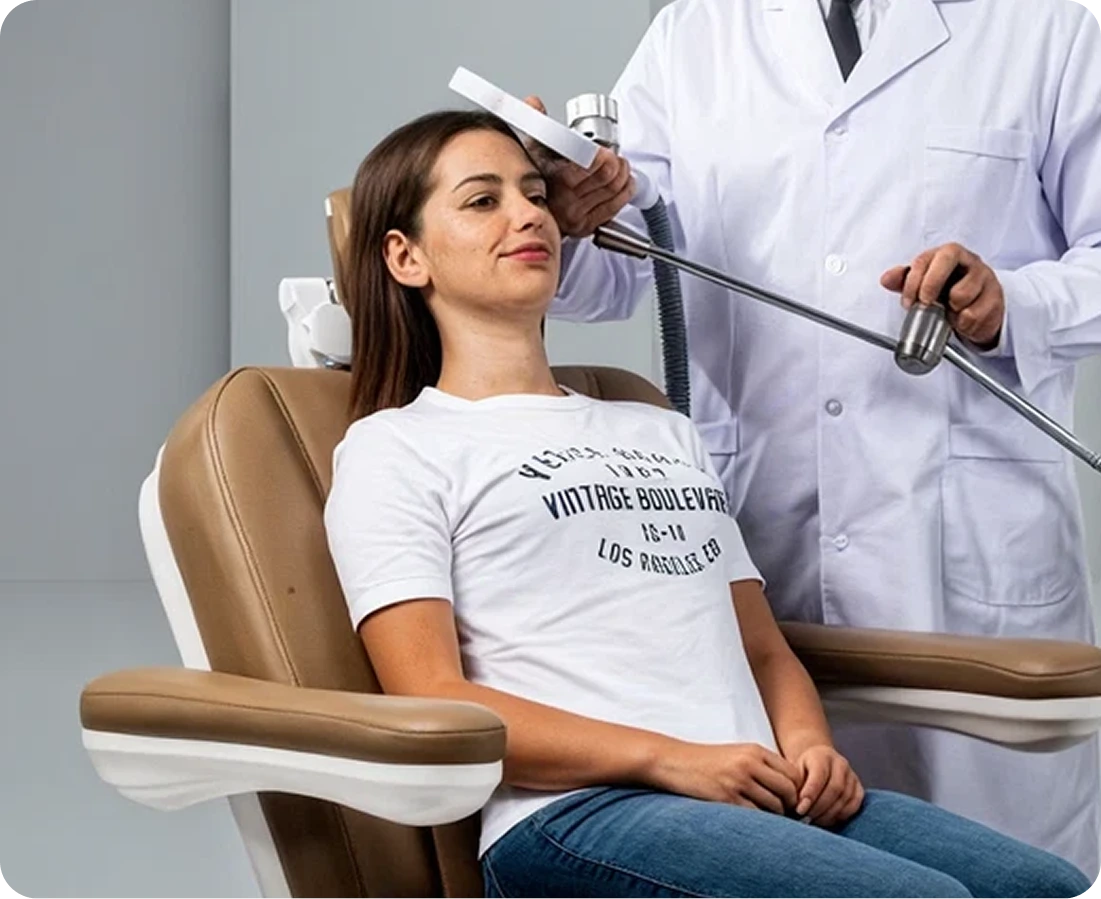
There is no sedation and no recovery period. Patients read, listen to music, or simply rest during treatment, then drive themselves home or straight to work. Symptom change is usually gradual: some notice small shifts within the first two weeks – sleeping better, feeling less driven by a particular ritual – while meaningful improvement more often emerges in the second half of the course.
Session
Duration
- Active stimulation: typically 18-20 minutes, depending on your prescribed protocol
- Total visit time: roughly 30 to 50 minutes with check-in and coil positioning
- First appointment: 60 to 90 minutes, including motor threshold mapping and target localization
- Standard schedule: daily sessions, five days a week, for approximately 4–6 weeks
- Accelerated option: the SAINT protocol delivers multiple shorter sessions per day over a condensed number of days

Potential Side Effects
- Scalp discomfort or tenderness at the treatment site
- Headache, usually responsive to over-the-counter pain relief
- Tingling, twitching, or spasm of facial muscles during stimulation
- Lightheadedness immediately after a session
- Seizure – an uncommon risk, minimized through careful medical screening
- Temporary hearing changes if ear protection is not used, which is why earplugs are provided at every session
Treatment Effectiveness & Results
Published research shows that a substantial proportion of patients who had not responded to medication and therapy achieve clinically meaningful reduction in symptom severity following a full course of TMS therapy. Response correlates with completing the prescribed number of sessions, so finishing the course matters.
Realistic expectations are part of good care. TMS is not typically a cure. For most patients, success looks like symptoms moving from disabling to manageable – enough relief that ERP therapy becomes effective, that work performance recovers, that relationships stop being organized around rituals.

Is TMS Right for You?
- Have a confirmed diagnosis of OCD from a qualified clinician
- Have tried at least one – often two or more – medication trial without adequate relief
- Have engaged in or attempted cognitive behavioral therapy, particularly ERP
- Cannot tolerate the side effects of psychiatric medications
- Are able to commit to a daily treatment schedule over several weeks
- Non-removable ferromagnetic metal or implanted electronic devices in or near the head – including certain aneurysm clips, cochlear implants, stents, and neurostimulators – are generally disqualifying
- Dental fillings, braces, and most orthopedic hardware elsewhere in the body are not a concern
- A personal history of seizures or epilepsy, significant head trauma, or any condition that lowers seizure threshold requires careful review
- Certain medications may warrant adjustment before beginning treatment
- We also assess for co-occurring conditions, such as bipolar disorder, substance use, or psychosis, that may change the plan
Benefits of TMS for OCD
Reduced intensity of intrusive thoughts
Greater ability to delay or skip compulsions
Improved daily functioning
No systemic drug side effects
No sedation or downtime
Preserved cognition
For Treatment-Resistant OCD
TMS can be highly effective for this condition. Rather than adjusting brain chemistry systemically through medication and hoping the right circuits respond, TMS stimulates the implicated network directly.
BrainHealth Solutions also offers psychiatric second opinions, and we encourage anyone with a long treatment history to consider one. Sometimes what looks like treatment-resistant OCD involves an unrecognized co-occurring condition, an under-dosed medication trial, or a diagnostic nuance that changes the plan entirely.
Cost of TMS Therapy in
Costa Mesa, CA
Why Patients Trust BrainHealth Solutions
Led by a Board-Certified Psychiatrist
A Full Spectrum of Advanced Options
Modern Technology, Human Environment
Personalized, Compassionate Care Focused on Lasting Results
Frequently Asked Questions
Does TMS hurt?
No. Most patients describe a tapping or flicking sensation on the scalp and hear a clicking sound during stimulation. Any discomfort is typically mild and fades within the first week of treatment.
Will I need to stop my medications?
Usually not. Most patients continue their current regimen during a TMS course. Dr. Bota reviews your medications during the consultation and will tell you if any adjustment is warranted.
How soon will I notice a difference?
Some patients report subtle changes within the first two weeks, but meaningful improvement more commonly develops during the second half of the treatment course, with full benefits often observed near completion.
Can I drive after a session?
Yes. TMS involves no sedation or anesthesia. You are alert throughout and can drive yourself home or to work immediately afterward and resume normal activities.
Is TMS the same as electroconvulsive therapy?
No. TMS requires no anesthesia, does not induce a seizure as part of treatment, and is not associated with the memory effects linked to ECT.
Do you accept insurance for TMS?
Coverage varies by carrier and diagnosis. Our team will help you check eligibility and provide the information you need for your inquiry, and CareCredit financing is available. Contact us, and we will review your specific situation.
What if TMS does not work for me?
We offer additional evidence-based options including SPRAVATO® (esketamine), the SAINT protocol, and medication management. Our team will work with you on the next appropriate step.
OCD does not have to define your day. If medication and therapy have not given you the relief you were promised, TMS may open a different door – and finding out takes one short conversation.
